Warlord
A commander whose force, courage, Titan, army, or battlefield presence can make history move before law knows how to name it.
A Warlord is not merely a weapon. Force can make plans real, but without design it may not outlast conquest.
This glossary gives first-reader meanings for recurring terms without flattening the secrets, custody chains, or final machinery the books are meant to reveal.
Start here when a word feels important but the story has not fully unfolded it yet.
A commander whose force, courage, Titan, army, or battlefield presence can make history move before law knows how to name it.
A Warlord is not merely a weapon. Force can make plans real, but without design it may not outlast conquest.
A language of lawful rule. It begins as a claim that power should protect roads, make surrender survivable, and bind violence under public law.
Do not treat it as only one throne, dynasty, empire, religion, or government.
The broad civilizational world of the saga: its empires, roads, houses, courts, Titans, records, prisons, ports, and old political memory.
Later societies inherit earlier words without always inheriting their meanings.
A major historical age. An era changes what familiar words mean as law becomes memory, fraud, threat, or inheritance.
Do not treat eras as clean breaks. Old worlds survive as habit, relic, route, name, or fear.
A family, political line, estate structure, or name-bearing power group, depending on context.
A recurring name is not automatically direct blood descent.
A recurring name pattern that may signal office, institutional function, public memory, prestige, or family.
Let the story prove whether a returned name is blood, office, echo, or repetition.
A political order large enough to make roads, courts, armies, taxes, records, and succession matter across generations.
Official language does not guarantee stability, unity, or honesty.
In this universe, documents and offices do not merely describe power. They move it.
A written, witnessed, sealed, hidden, public, or false account that can change what power is allowed to do.
Do not trust a record only because it is official, and do not dismiss one because it is small.
A structured record of names, debts, claims, transfers, injuries, property, duties, or memory.
What gets counted, and what gets left out, is political.
A mark, object, or authority-sign that can make a record, command, transfer, or claim sound lawful.
Ask who can use it, who recognizes it, and who is endangered by it.
A written legal instrument: an order, claim, accusation, authorization, or testimony.
A writ can be a weapon without looking like one.
A system that classifies names, property, status, access, obligations, or ownership.
A registry can make a person visible, invisible, protected, seized, or trapped.
A design mind who understands that tactics become law, law becomes memory, and necessary victories can become future disasters.
Do not call every clever strategist an Architect. A brilliant mind still needs force capable of making design real.
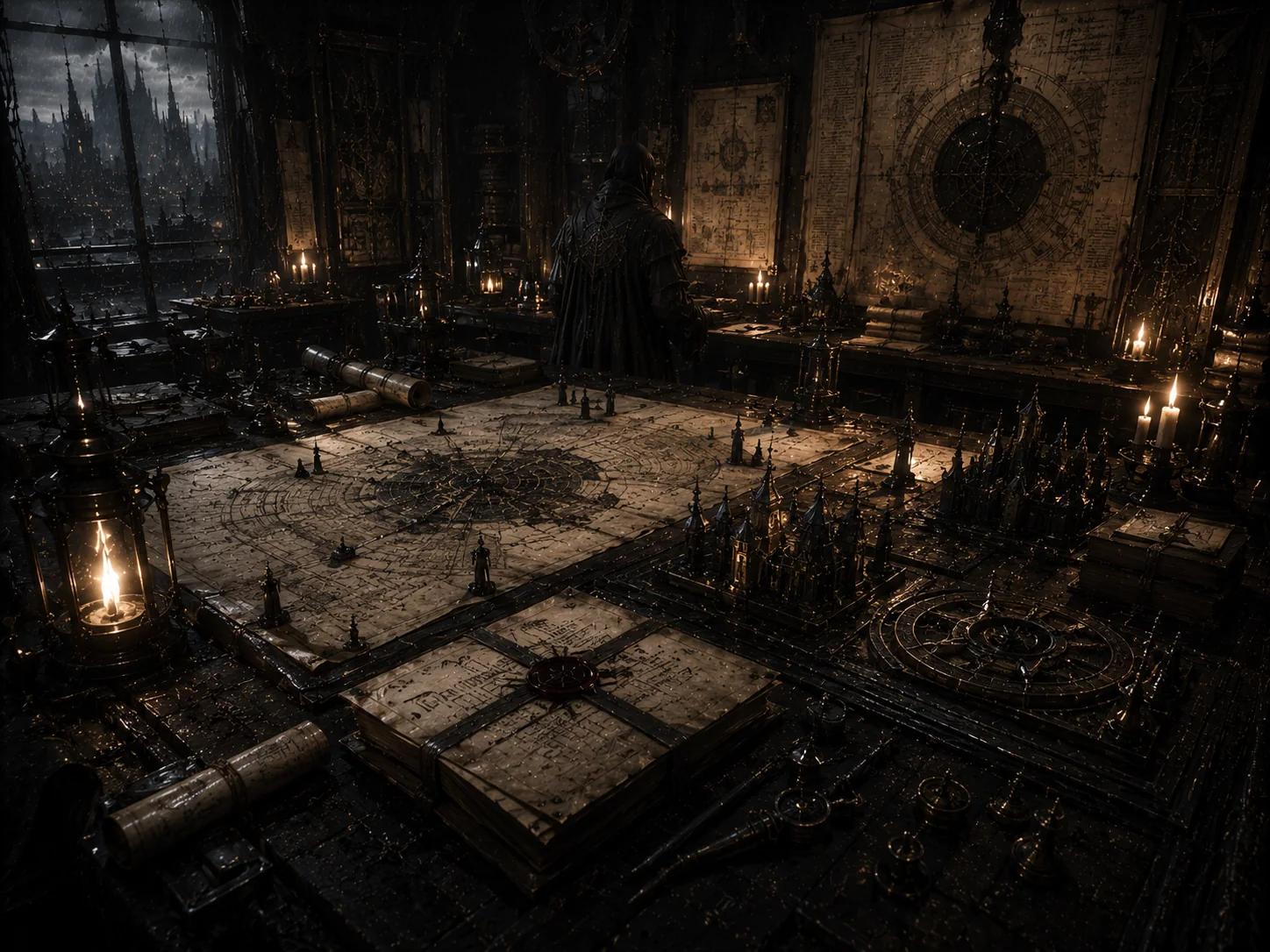
Core dramatic engine
Warlords move history. Architects decide what shape remains. The books are strongest when force and design need each other, resist each other, and leave consequences neither side can fully control.
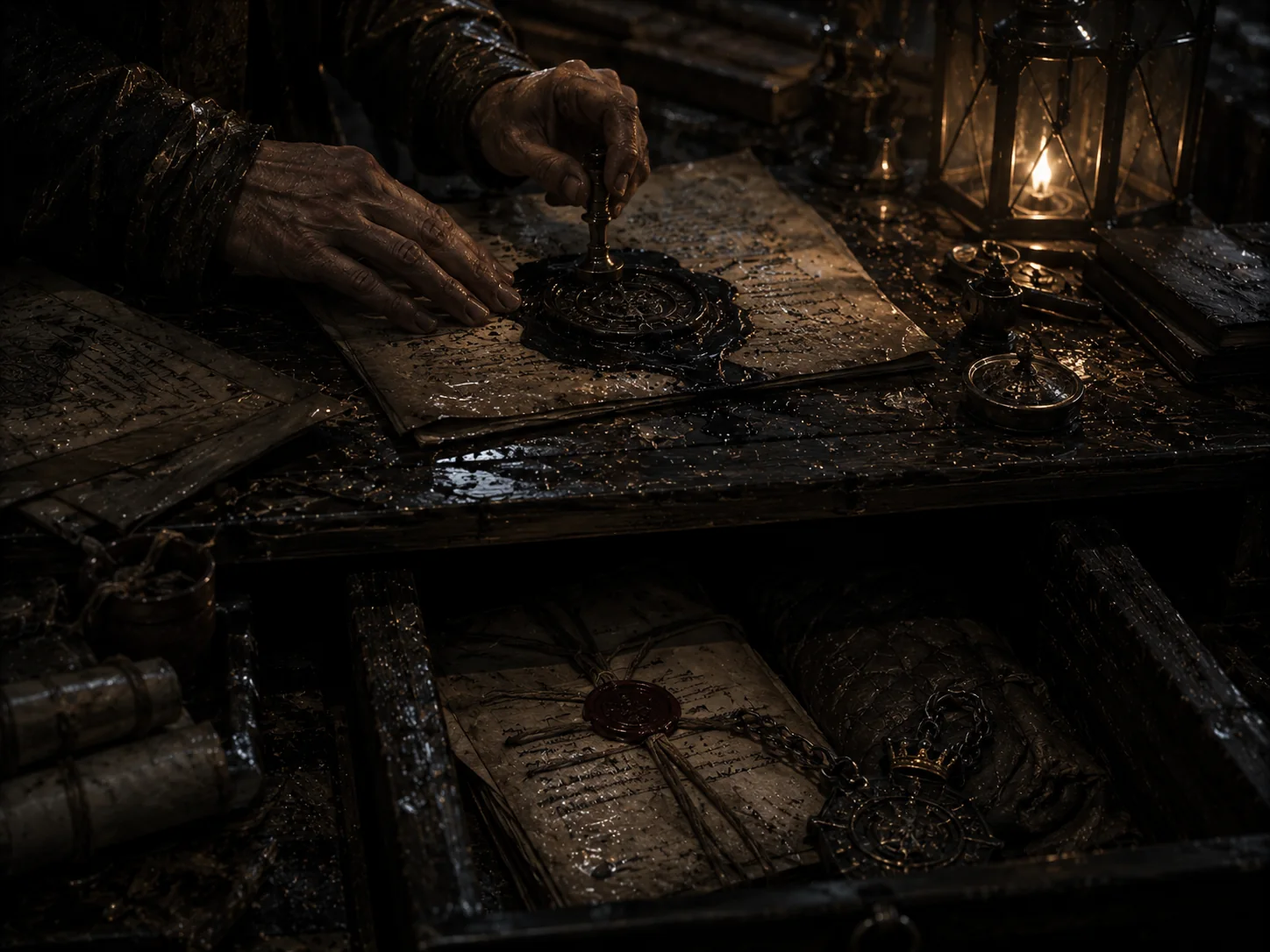
Glossary visual anchor
Use this image when the books make law feel small, wet, sealed, and dangerous. The table holds the official instrument; the lower drawer holds the testimony power is trying not to see.
The setting often explains itself through movement, custody, and what old objects still make people recognize.
The civil body of the world: what law claims to protect, armies try to control, and the erased use to survive.
Movement often tells you who the law serves.
A controlled passage: military, legal, civic, symbolic, or all of those at once.
A gate asks who is allowed through, who pays, who is recorded, and who is stopped.
A route-linked system for carrying information, orders, warnings, or records.
Whoever controls the route of information can change the shape of truth.
Not only a giant war machine. A Titan is a sovereignty body: political proof, command frame, relic, terror engine, inherited estate, or public argument made of metal.
Ask what authority moved with it.
An old object whose political meaning has outlived its first owner.
Its danger often comes from recognition.
A caution label for objects or systems that may look like Titans, relics, vessels, arrays, or mechanisms but should not be forced into one class too early.
Let mysteries stay unclassified until the story earns the category.
Outlaws is the most human entrance for records, roads, writs, registries, and the cost of law at ordinary scale.
Full Titan transfer chains, hidden genealogy, ending machinery, and after-reading record links belong behind spoiler control until the books reveal them.